
Over the past years, the network ecosystem has changed dramatically, the focus of CSPsCSPs are integrated solution providers. They usually serve both residential and business customers with personalized solutions. They are usually focused on mobile, broadband and TV.... ... now stretching beyond the scope of CSP interconnection. Today, CDNsCDNs are networks of servers and caches used to bring content closer to the end-users in the internet, by that reducing latency, jitter and QOE-volatility... ... have developed into large network players, who now deploy their own infrastructure to keep up with increasing traffic volumes. However, they do so without proper knowledge of CSP network characteristics, like architecture, subscriber allocation and capacity availability.
As a result, CSPsCSPs are integrated solution providers. They usually serve both residential and business customers with personalized solutions. They are usually focused on mobile, broadband and TV.... ... have lost oversight of their networks. Without the ability to see how the other is behaving, both CSPsCSPs are integrated solution providers. They usually serve both residential and business customers with personalized solutions. They are usually focused on mobile, broadband and TV.... ... and CDNsCDNs are networks of servers and caches used to bring content closer to the end-users in the internet, by that reducing latency, jitter and QOE-volatility... ... are stuck wasting their resources to come up with educated guesses that may or may not optimize content delivery.
Stop guessing. Start knowing.
By providing sufficient transparency between CSPsCSPs are integrated solution providers. They usually serve both residential and business customers with personalized solutions. They are usually focused on mobile, broadband and TV.... ... and CDNsCDNs are networks of servers and caches used to bring content closer to the end-users in the internet, by that reducing latency, jitter and QOE-volatility... ..., we take the guesswork out of network mapping, making content delivery predictable and more reliable. This means delivering in-demand content faster to happy CSP and CDNCDNs are networks of servers and caches used to bring content closer to the end-users in the internet, by that reducing latency, jitter and QOE-volatility... ... customers.
Flow Director for Communications Service Providers
BENOCS FlowFlow is the movement of data traffic between two points in a network. Flow can also refer to a type of network protocol that is... ... Director is a network traffic management and optimization tool. It is the first ever solution that allows CSPsCSPs are integrated solution providers. They usually serve both residential and business customers with personalized solutions. They are usually focused on mobile, broadband and TV.... ... to facilitate optimal network traffic conditions and improve their network visibility through an automated mapping-data exchange with CDNsCDNs are networks of servers and caches used to bring content closer to the end-users in the internet, by that reducing latency, jitter and QOE-volatility... .... FlowFlow is the movement of data traffic between two points in a network. Flow can also refer to a type of network protocol that is... ... Director gives ISPs the ability to share the relevant part of their valuable data on network topology and network status that they naturally collect on CDNCDNs are networks of servers and caches used to bring content closer to the end-users in the internet, by that reducing latency, jitter and QOE-volatility... ... behavior, thus allowing CDNsCDNs are networks of servers and caches used to bring content closer to the end-users in the internet, by that reducing latency, jitter and QOE-volatility... ... to make better content delivery decisions.
One of the major challenges facing CSPsCSPs are integrated solution providers. They usually serve both residential and business customers with personalized solutions. They are usually focused on mobile, broadband and TV.... ... today is their lack of control over incoming content traffic combined with little network oversight. CDNsCDNs are networks of servers and caches used to bring content closer to the end-users in the internet, by that reducing latency, jitter and QOE-volatility... ... have become the dominant traffic player over the last decade – the top 5 CDNsCDNs are networks of servers and caches used to bring content closer to the end-users in the internet, by that reducing latency, jitter and QOE-volatility... ... produce more than 50% of traffic on most networks – but are still difficult for most CSPsCSPs are integrated solution providers. They usually serve both residential and business customers with personalized solutions. They are usually focused on mobile, broadband and TV.... ... to monitor and control. Without the ability to communicate with CDNCDNs are networks of servers and caches used to bring content closer to the end-users in the internet, by that reducing latency, jitter and QOE-volatility... ... networks and deployments, CSPsCSPs are integrated solution providers. They usually serve both residential and business customers with personalized solutions. They are usually focused on mobile, broadband and TV.... ... experience network bottlenecks (especially during peak-hours) and unnecessary detours of traffic. These factors can translate into customer dissatisfaction and excess network expenses. BENOCS FlowFlow is the movement of data traffic between two points in a network. Flow can also refer to a type of network protocol that is... ... Director offers CSPsCSPs are integrated solution providers. They usually serve both residential and business customers with personalized solutions. They are usually focused on mobile, broadband and TV.... ... real-time CDNCDNs are networks of servers and caches used to bring content closer to the end-users in the internet, by that reducing latency, jitter and QOE-volatility... ... visibility as well as an inexpensive opportunity to help steer CDNCDNs are networks of servers and caches used to bring content closer to the end-users in the internet, by that reducing latency, jitter and QOE-volatility... ... traffic on the best path, thus improving user experience (UX) as well as network utilization.
Thanks to its interoperability with standardized protocols of CSP network infrastructure and its scalability, BENOCS FlowFlow is the movement of data traffic between two points in a network. Flow can also refer to a type of network protocol that is... ... Director fits every kind of network.
Benefits for CSPs
- Better traffic distribution during peak hours for 20% savings in backbone CapExCapital Expenditure: Funds used by a company to acquire, upgrade and maintain physical assets such as property, plants, buildings, technology, or equipment, like hardware for... ...
- Proactive, adaptive and automated planning of network upgrades with up to 15% CapExCapital Expenditure: Funds used by a company to acquire, upgrade and maintain physical assets such as property, plants, buildings, technology, or equipment, like hardware for... ... savings
- Better quality of experience for network subscribers
How it works
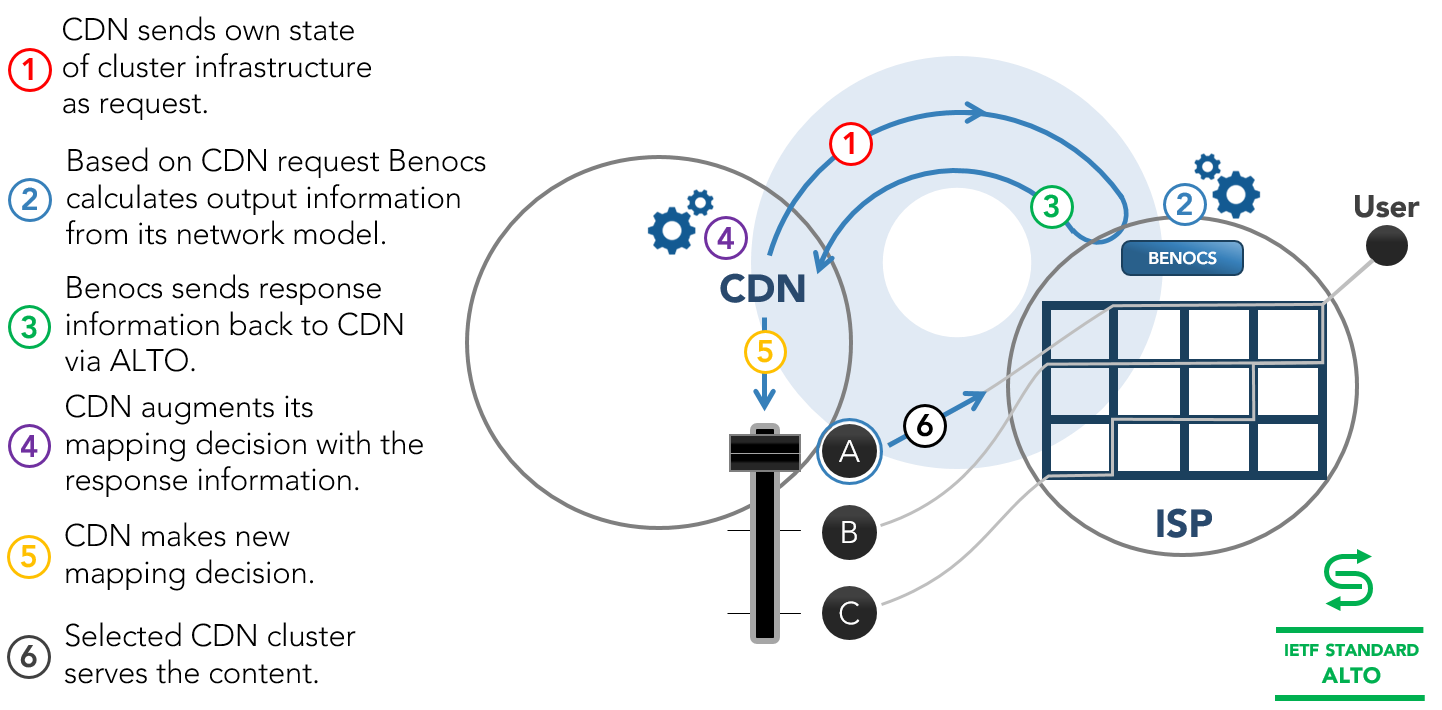
By deploying BENOCS FlowFlow is the movement of data traffic between two points in a network. Flow can also refer to a type of network protocol that is... ... Director in the CSP network, CSPsCSPs are integrated solution providers. They usually serve both residential and business customers with personalized solutions. They are usually focused on mobile, broadband and TV.... ... send assign preferences of server-to-client paths to CDNsCDNs are networks of servers and caches used to bring content closer to the end-users in the internet, by that reducing latency, jitter and QOE-volatility... ... through automated signaling between the FlowFlow is the movement of data traffic between two points in a network. Flow can also refer to a type of network protocol that is... ... Director and the CDNCDNs are networks of servers and caches used to bring content closer to the end-users in the internet, by that reducing latency, jitter and QOE-volatility... .... The CDNCDNs are networks of servers and caches used to bring content closer to the end-users in the internet, by that reducing latency, jitter and QOE-volatility... ... then chooses the best path based on path length and congestion. This results in 100% shortest path delivery and zero network traffic congestion.
BENOCS Flow Director for Content Delivery Networks

BENOCS FlowFlow is the movement of data traffic between two points in a network. Flow can also refer to a type of network protocol that is... ... Director is a network traffic management and optimization tool that provides CDNsCDNs are networks of servers and caches used to bring content closer to the end-users in the internet, by that reducing latency, jitter and QOE-volatility... ... data from CSPsCSPs are integrated solution providers. They usually serve both residential and business customers with personalized solutions. They are usually focused on mobile, broadband and TV.... ... on network topology. With this data, CDNsCDNs are networks of servers and caches used to bring content closer to the end-users in the internet, by that reducing latency, jitter and QOE-volatility... ... receive visibility of network traffic conditions and network topology, which enables them to always find the shortest uncongested path to any subscriber in the network.
By enhancing CDNs’ mapping-systems with real-time end-to-end path visibility, BENOCS FlowFlow is the movement of data traffic between two points in a network. Flow can also refer to a type of network protocol that is... ... Director provides fully informed delivery control through partnering-interfaces. This gives CDNsCDNs are networks of servers and caches used to bring content closer to the end-users in the internet, by that reducing latency, jitter and QOE-volatility... ... the necessary information to make better content delivery decisions for faster delivery service, resulting in a better quality of experience, and stabilized, organic utilization patterns on server clusters, which in turn, allows for savings on CapExCapital Expenditure: Funds used by a company to acquire, upgrade and maintain physical assets such as property, plants, buildings, technology, or equipment, like hardware for... ....
How it works
By deploying BENOCS FlowFlow is the movement of data traffic between two points in a network. Flow can also refer to a type of network protocol that is... ... Director, CDNsCDNs are networks of servers and caches used to bring content closer to the end-users in the internet, by that reducing latency, jitter and QOE-volatility... ... receive assigned preferences of server-to-client paths through automated signaling between FlowFlow is the movement of data traffic between two points in a network. Flow can also refer to a type of network protocol that is... ... Director – in the CSP network – and the CDNCDNs are networks of servers and caches used to bring content closer to the end-users in the internet, by that reducing latency, jitter and QOE-volatility... ... about network regions and network state.
Benefits for CDNs
- 90% of all connections improve their speed by up to 20%
- More efficient usage of delivery infrastructure means 15% reduction in server infrastructure costs
- 20% OpEx savings in infrastructure operations by scaling audiences